
Trip from Finland to Ethiopia? Regardless of the purpose of your trip tourism, business, or transit, getting a grip on the Ethiopian eVisa process is a must. This guide demonstrates all the things that Finnish nationals need to be informed about when it comes to applying for an Ethiopian eVisa such as who can apply, Ethiopia e Visa for Finland Citizens what documents are needed, how long it takes for a visa to be issued, and also some useful travel hints.
Which is Better: eVisa or Visa on Arrival?
Selecting an eVisa or a visa on arrival is a matter of convenience, timeliness, and certainty:
- eVisa is quicker and more expedient – You can pre-book the eVisa online and skip the airport's long lines.
- On the other hand, visa on arrival might be one of the sources of uncertainty – There can be at times delays, availability restrictions, and even stricter checks of documents.
- eVisa gives vetting approval prior to travel – It minimizes the worry over travel by letting you know beforehand that your entry would be allowed.
- Also, visa on arrival might be a more expensive option – Some countries impose a higher fee for a visa issued at the airport compared to an eVisa.
- eVisa is better for the assembling of itineraries – Particularly for the hectic traveling plans, it secures the trouble-free entrance without any last-minute problems.
For travel without any hassle, eVisa is normally the comfortable option over visa on arrival; however, visa on arrival can still be a good choice for unplanned trips.
How many days does Ethiopia eVisa processing take for Finland Citizens?
This segment gives the applicants the choice of the pace of the visa application to be processed. Depending on the urgency of the case and your travel plans, you could choose the suitable option.
- Normal Processing (5–8 Working Days): The best option for those who apply early and need no instant approval.
- Rush Processing (2–5 Working Days): It is the case for applicants with the travel dates just around the corner and thus requiring swift processing.
- Super Rush Processing (1–3 Working Days): It is the option that suits very urgent or last-minute trips best and necessitates the quickest decision.
Choose the time needed for processing according to your travel date.
What documents do I need for an Ethiopia eVisa?
In this part of the application form, the submission of critical documents is demanded for the processing of your request.
Passport Bio Page: You need to upload a high-quality scan of the personal data page of your passport.
Applicant Photo: You need to upload a recent passport photo with a plain background.
Can I Travel to Ethiopia Without a Yellow Fever Vaccine?
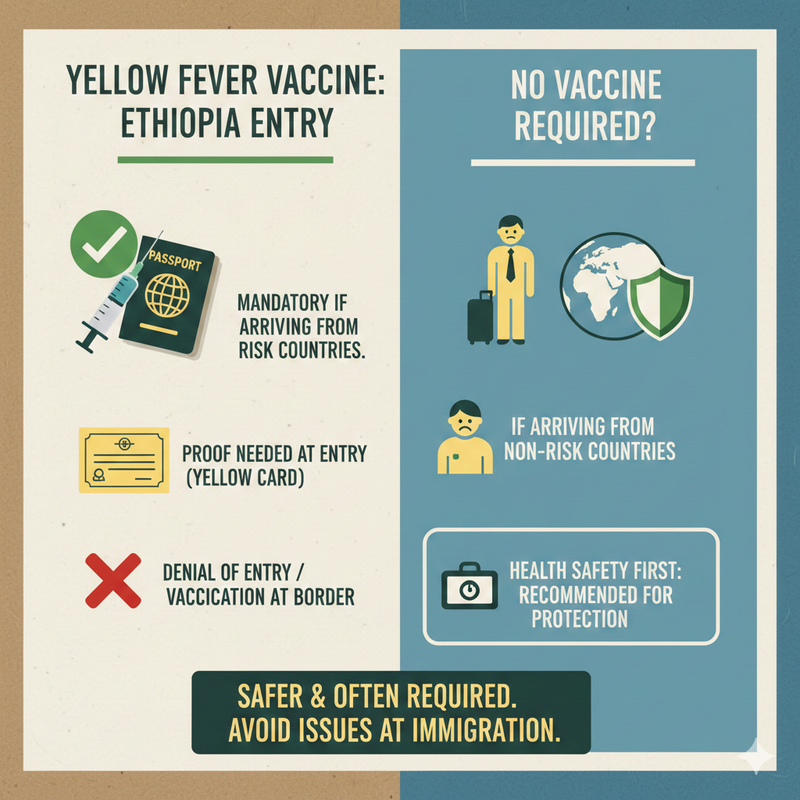
Traveling to Ethiopia without a yellow fever vaccination depends on your travel history and entry requirements:
- Mandatory for some travelers – If you are coming from or have recently visited a country with a risk of yellow fever, vaccination is required.
- Proof needed at entry – Ethiopia may ask for a Yellow Fever Certificate at the airport.
- No vaccine may cause denial – Without it, entry could be refused or you may need to get vaccinated at the border.
- Not always needed – If you are arriving from a country without yellow fever risk, the vaccine may not be required.
- Health safety first – Even if not mandatory, vaccination is strongly recommended to protect yourself.
While some travelers may enter Ethiopia without a yellow fever vaccine, it is safer and often required to have the certificate to avoid issues at immigration.
Does Your Ethiopia eVisa Get Stamped?
Travelers often wonder if an Ethiopia eVisa gets physically stamped in their passport:
- Ethiopia eVisa is fully electronic, no physical stamp is placed in your passport.
- Immigration officials verify your eVisa digitally using your passport number.
- Carry your passport, as it is still required for identification.
- Keep a printed or digital copy of your eVisa confirmation for reference.
- eVisa speeds up entry and avoids long visa-on-arrival queues.
How much is the eVisa fee for Ethiopia?
The eVisa for Ethiopia requires the payment of an Ethiopia eVisa Fee, which is influenced by the type of visa and the duration of stay, hence it depends on Ethiopia.
- The fees for eVisas differ according to the type of eVisa such as tourist, business, or transit visa.
- In the case of extending the stay, the fee may need to be changed.
- The payment will be completed using a secure online method and credit or debit cards will be accepted.
- Usually, there are no refunds for the fees that have been paid.
- It is recommended to check the official website for the most up-to-date fee information before submitting the application.
Is an Ethiopia eVisa Required for Minors?
Traveling to Ethiopia isn’t just for adults—children and minors also need to meet entry requirements. Here’s what you need to know:
- Yes, minors need an eVisa – All children, regardless of age, must have their own eVisa to enter Ethiopia.
- Separate application – Each minor must have a separate online application.
- Passport mandatory – A valid passport is required for every minor.
- Parental consent – Sometimes, parents or legal guardians must provide authorization for the application.
- Same entry rules – Minors follow the same entry procedures as adults once the eVisa is approved.
Am I Allowed to Leave the Airport if I Have a Connecting Flight?
If you have a layover in Ethiopia, you might wonder whether you can explore the city or step outside the airport before your next flight. Here’s what you need to know:
- Depends on your visa – If you have a valid Ethiopia eVisa, you can leave the airport during your layover.
- Visa on arrival may also allow it – Travelers with visa-on-arrival can usually leave, but check local rules.
- Short layovers may be restrictive – For very short connections, it’s safer to stay inside the airport to avoid missing your flight.
- Immigration check required – You will go through immigration both entering and returning to the airport.
- Plan time carefully – Ensure enough time to exit, explore, and return to clear security for your next flight.
Is Dual Citizenship Allowed in Ethiopia?
If you are considering moving to or traveling long-term in Ethiopia, you may wonder about holding more than one nationality. Here’s what you need to know:
- Dual citizenship is generally not allowed – Ethiopia does not officially recognize dual citizenship for adults.
- Ethiopian law requires single nationality – Ethiopian citizens are expected to hold only Ethiopian citizenship.
- Exceptions for minors – Children born abroad may temporarily hold dual citizenship until they reach adulthood.
- Renunciation may be required – Citizens acquiring another nationality may be asked to renounce Ethiopian citizenship.
- Legal consequences – Violating this can cause issues with passports, government services, or legal rights in Ethiopia.
Is It Better to Get an eSIM or Physical SIM in Ethiopia?
When traveling to Ethiopia, staying connected is important. Choosing between an eSIM and a physical SIM card depends on convenience, cost, and flexibility. Here’s a breakdown:
- eSIM is convenient – You can activate it digitally without visiting a store.
- Physical SIM widely available – Local stores sell physical SIM cards easily, sometimes with better local support.
- Cost comparison – eSIMs may be slightly more expensive, while physical SIMs are usually cheaper for local calls and data.
- Compatibility – eSIM works only on compatible smartphones, whereas physical SIMs work on almost all phones.
- Travel flexibility – eSIM is great for short trips or multi-country travel, while physical SIMs are better for longer stays.
What Is the Main Transportation in Ethiopia?
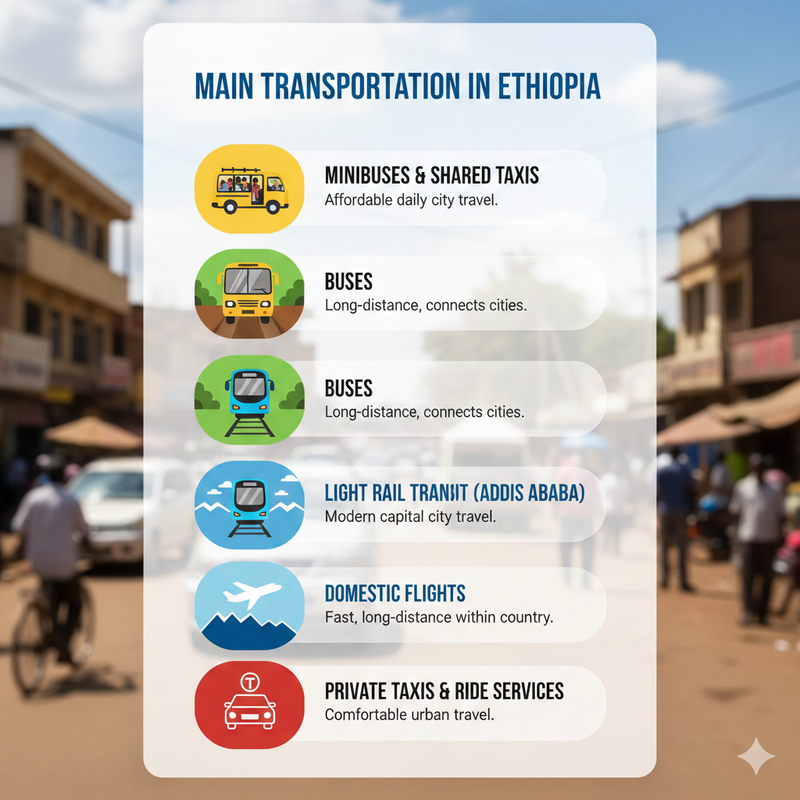
Ethiopia offers a mix of traditional and modern transportation options, making it easier for travelers to move within cities and across regions. The most common modes include:
- Minibuses and shared taxis – The most widely used and affordable option for daily travel in cities.
- Buses – Long-distance buses connect major cities and towns across Ethiopia.
- Light Rail Transit (Addis Ababa) – A modern and efficient option for getting around the capital city.
- Domestic flights – A fast and convenient way to travel long distances within the country.
- Private taxis and ride services – Easily available in urban areas for comfortable travel.
What Do People Do in Ethiopia?

Ethiopia has a rich culture and a diverse economy, and daily life varies between cities and rural areas. Here’s what people commonly do in Ethiopia:
- Agriculture and farming – Many people work in farming, growing crops like coffee, grains, and vegetables.
- Trade and small businesses – Markets, shops, and street vending are an important part of daily life.
- Office and government jobs – In cities, people work in administration, education, healthcare, and services.
- Cultural and religious activities – Traditional ceremonies, festivals, and religious practices are central to life.
- Tourism and hospitality – Some people work as guides, hotel staff, or artisans supporting tourism.
Conclusion
The Ethiopia eVisa is an easy and hassle-free way to go to Ethiopia for Finnish citizens. They can simply and easily apply online without having to go to the embassy. The application procedure is simple, the processing time is fast, and the electronic approval is sent via email. Hence, it is a perfect choice for tourists or people on short visits.
Comments